Spotify Paid $11 Billion to Music in 2025: The Gap Between Industry Money and Your Share

By Tami LaTrell
DIAGNOSIS: The industry record is real. So is the gap.
Spotify says it paid more than $11 billion to music rights holders in 2025, up more than 10% from the year before. Roughly half of those royalties were generated by independent artists and labels, while Spotify’s lifetime payouts to the music industry approached $70 billion.
That’s significant growth.
But here’s the hard truth: industry-level money is not the same as your share of it.
You can see a headline about record payouts and still open your statement to find that nothing moved. Your streams may be growing. Your catalog may be active. Your songs may be earning money somewhere in the system.
But are the right records connected?
Spotify’s Loud & Clear reporting explains the size and movement of streaming royalties. It does not mean every dollar generated by your music arrives in your personal statement automatically. Money still has to move through distributors, labels, publishers, performing rights organizations, mechanical licensing systems, and collection services.
If your data is incomplete, the chain breaks.
More industry money does not guarantee more money to you. Matched rights do.
ROYALTY EDUCATION: What “unclaimed” actually means
When people hear unclaimed music royalties, they often imagine money that disappeared. More accurately, the money may have been collected but not connected to the correct song, ownership share, or rights holder.
The MLC’s public dashboards show why this matters.
For January 2021 usage, The MLC reports $6.30M remaining ($3.24M unmatched, $3.06M unclaimed) out of $53.88M reported.
Supporting dashboard details for that January 2021 period show:
- $47.47 million distributed
- $0.11 million in dispute
- $6.30 million remaining unclaimed
- $3.24 million unmatched
- $3.06 million unclaimed after a song was matched but not all shares were claimed
Across the first 12 months of 2021, the dashboard reports $75.13M remaining ($37.13M unmatched, $38.00M unclaimed) out of $674.89M reported, with $1.63M in dispute.
Supporting dashboard details for that first-12-month period show:
- $598.12 million distributed
- $1.63 million in dispute
- $75.13 million remaining
- $37.13 million unmatched
- $38.00 million unclaimed
Some MLC dashboard views cite dispute amounts of $1.16 million/$1.63 million, depending on the reporting view. The detailed January row shows $0.11 million, while the first-12-month total shows $1.63 million.
The MLC plans to begin market-share distributions in 2027, starting with blanket royalties from January 2021 usage. That makes your catalog review more urgent, not because every unmatched royalty is already gone, but because matched data is the only thing that unlocks an unclaimed balance before redistribution rules apply.
Read the MLC Unclaimed Accrued Royalties dashboard and MLC dashboard overview for the current reporting.
Five catalog gaps that can separate you from your money
1. Missing titles
What’s the gap?
A song may exist on a DSP, distributor report, or royalty statement under a title that never appears in your publishing records.
This happens with alternate titles, working titles, spelling changes, translations, clean versions, deluxe versions, and songs released under different project names.
Why does it break the royalty chain?
If the title in a usage report does not connect to the title registered with the relevant rights organization, the use may remain unmatched. The recording is earning attention, but the composition is difficult to identify.
What The Mezzo Agency looks for in review
We compare official titles, alternate titles, versions, release dates, writers, publishers, and linked recordings to see whether the same work is being described differently across systems.
Watch out: a title that looks “close enough” to a human may not be close enough for a data system.
2. Missing or unconfirmed splits
What’s the gap?
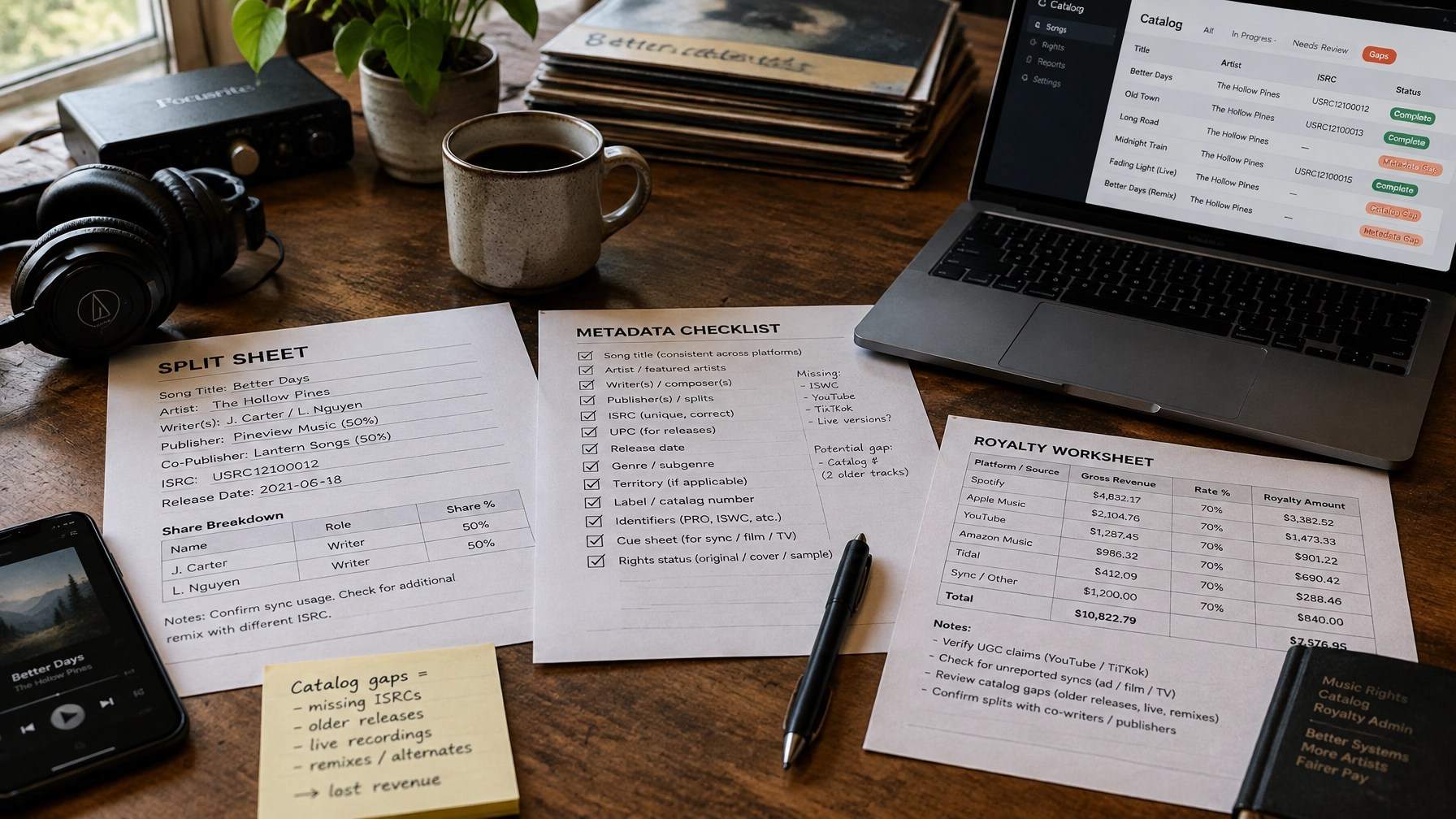
A split is the ownership percentage assigned to each songwriter, producer, publisher, or other rights holder.
If the split sheet is missing, unsigned, contradictory, or incomplete, the system may recognize the song but still be unable to distribute every share.
Why does it break the royalty chain?
This is one reason royalties become unclaimed music royalties rather than paid royalties. A song can be matched while one or more ownership shares remain unclaimed.
That affects songwriter royalties, producer royalties, music publishing royalties, and future licensing decisions.
What The Mezzo Agency looks for in review
We look for signed split documentation, consistent legal names and writer names, publisher information, ownership percentages, and any contradictions between agreements, registrations, and statements.
No confirmed split, no clean path to payment.
3. Incomplete registrations
What’s the gap?
A creator may register a recording with a distributor but never register the underlying composition with the organizations responsible for publishing and mechanical royalties.
This is where many independent creators get caught. They know how to upload music. They have not been shown how royalty registration works across every relevant lane.
Why does it break the royalty chain?
A distributor may report master recording income while your publishing income remains unregistered. Performance royalties, mechanical royalties, and other music publishing royalties can sit outside the statement you regularly check.
What The Mezzo Agency looks for in review
We review whether each song is represented across the appropriate layers of the royalty system:
- The recording earns one set of rights.
- The composition earns another.
- The writers and publishers may have separate shares.
- Different uses may flow through different organizations.
Talent creates the opportunity. Infrastructure protects the value.
4. Missing or mismatched IDs
What’s the gap?
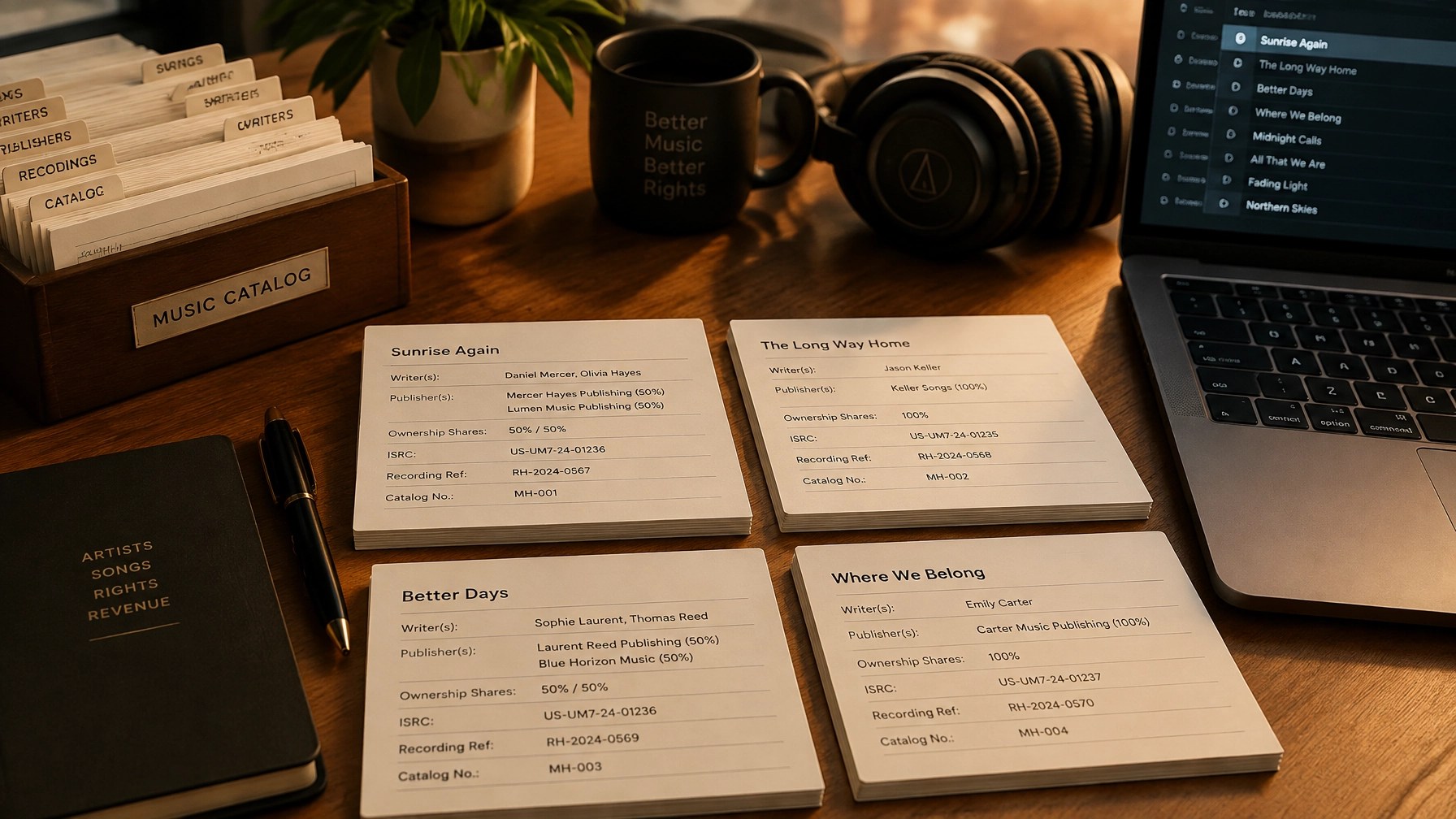
Music systems rely on identifiers. Common examples include ISRCs for sound recordings, ISWCs for musical works, catalog numbers, and creator or publisher identifiers.
If an ID is missing, duplicated, entered incorrectly, or attached to the wrong version, the system may not connect usage to the correct asset.
Why does it break the royalty chain?
A recording can be counted separately from its other versions. A remix can be confused with the original. A song can be connected to the wrong writer or publisher. These mismatches create missing music royalties across DSP, PRO, mechanical, and licensing reports.
What The Mezzo Agency looks for in review
We trace the relationship between title, recording, composition, ownership, and identifier data to find where an asset is being described inconsistently across platforms or records.
IDs are not technical decoration. They are the address where your royalties are supposed to arrive.
5. Bad metadata
What’s the gap?
Metadata is the information that describes and identifies your music: title, artist name, featured artist, writers, publishers, genre, release date, copyright information, identifiers, and ownership.
Bad metadata can be incomplete, inconsistent, outdated, or different from one platform to another.
Why does it break the royalty chain?
Everything downstream becomes harder. Matching slows down. Duplicate records appear. Royalty reports become difficult to reconcile. Your catalog becomes harder to value, license, administer, and protect.
Metadata problems also affect how you understand your own earnings. If your information is spread across emails, spreadsheets, distributor dashboards, and old agreements, you may not know whether a payment is missing or simply sitting in another royalty lane.
What The Mezzo Agency looks for in review
We compare metadata across releases, registrations, statements, agreements, and supporting documents to see whether one controlled record of the catalog actually exists.
Clean metadata turns a pile of releases into an administrable catalog.
ROYALTY EDUCATION: One stream can create multiple royalty paths
A Spotify stream can involve more than one type of payment.
The master recording side may move through your distributor, label, or other recording-rights partner. The composition side can generate mechanical royalties and performance royalties. Depending on the use and territory, additional collection organizations may be involved.
This is why learning how to collect music royalties requires more than watching one DSP statement.
The MLC pays digital mechanical royalties for eligible streaming uses on digital service providers. HFA pays mechanical royalties connected to physical copies. The Mezzo Agency checks both lanes because a catalog can look complete in the digital environment while physical or licensing information remains incomplete.
The RIAA’s 2025 mid-year report also shows why physical context still matters: physical music generated $576.4 million in U.S. wholesale revenue during the first half of 2025, with vinyl representing more than three-quarters of physical revenue.
Streaming may dominate the conversation. It does not eliminate the need to organize every royalty lane.
CATALOG INFRASTRUCTURE: Build the record before you need the money
Good music catalog management is not just file storage. It is the process of connecting:
- The song
- The recording
- The ownership
- The registrations
- The usage
- The payment
That is the foundation of a reliable royalty system.
When The Mezzo Agency reviews a catalog, we are looking for whether those six points actually connect across the documentation. For every work, that means confirming the official title, alternate titles, writers, publishers, split information, registration status, identifiers, recordings, release information, and supporting agreements.
Then we compare that catalog against:
- Distributor statements
- PRO repertories
- The MLC account
- HFA or physical-mechanical records
- SoundExchange records where applicable
- Licensing activity
- Royalty statements and payment histories
This is the practical purpose of a music royalty audit or music catalog audit: not to create more paperwork, but to identify where the chain between use and payment is weak.
Talent creates the opportunity. Infrastructure protects the value.
SOLUTIONS: What The Mezzo Agency checks
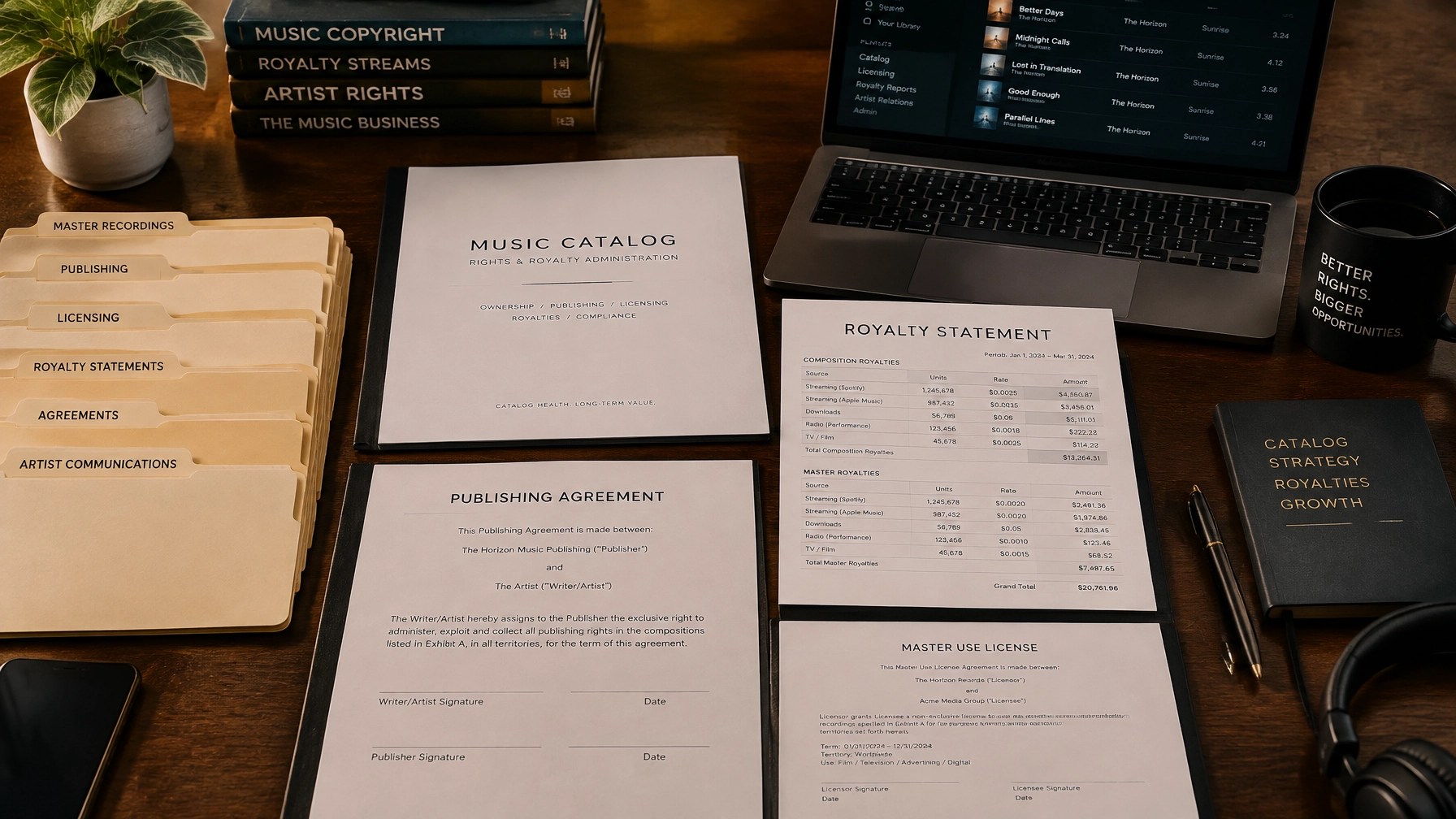
The Mezzo Agency’s catalog administration work is centered on the infrastructure behind royalty collection and music rights management.
We check:
- Whether titles, alternate titles, recordings, and compositions are consistently documented
- Whether songwriter, producer, and publisher splits are confirmed
- Whether registrations are complete across the relevant royalty lanes
- Whether ISRCs, work identifiers, catalog numbers, and other IDs match
- Whether metadata is accurate across releases, registrations, and statements
- Whether digital mechanical royalties are represented through The MLC
- Whether physical mechanical royalties are represented through HFA
- Whether publishing, performance, and licensing information is organized for review
- Whether royalty statements can be connected back to specific works and ownership shares
The goal is visibility.
You should be able to look at your catalog and understand what you own, where it is registered, how it is being used, and which payment path applies.
Spotify’s $11 billion payout shows that money is moving through the global music economy. Your next question should be more specific:
Is your catalog organized well enough to connect your work to your share?
Talent creates the opportunity. Infrastructure protects the value.
Save this breakdown, share it with an artist, songwriter, producer, or publisher, and read the full music administration and rights education library from The Mezzo Agency.
Sources

You Might Also Like


