MLC Unclaimed Royalties: 2027 Distributions Are Coming — Why Songwriters Need Organized Catalogs Now

By Tami LaTrell, Music Publishing Executive and Rights Strategist
The MLC intends to begin the market-share distribution process for remaining unclaimed accrued blanket royalties in 2027.
When that process begins, it will start with royalties from January 2021, the first month that digital service providers reported royalties under the blanket license administered by The MLC, and continue month by month thereafter.
That means your catalog organization matters now.
Not next year. Not after you hear about the first payment. Now.
The hard truth is that the 2027 process will not function like a second registration window for every unmatched song. Once a month’s remaining unclaimed royalties are distributed through the market-share process, those specific uses are no longer available for the original rightsholder to claim directly.
If your catalog isn’t organized, your money may be impossible to match before the deadline. Talent creates the opportunity. Infrastructure protects the value.
What are the 2027 MLC market-share distributions?
The Music Modernization Act requires The MLC to continue efforts to match and distribute royalties for a statutory holding period. After that period, remaining unclaimed accrued royalties may be distributed through a market-share process.
Unclaimed accrued royalties include:
- Unmatched royalties: Money The MLC received but could not connect to the correct song or rightsholder.
- Unclaimed royalties: Money connected to a song, but one or more ownership shares have not been claimed by a registered MLC member.
The MLC plans to distribute one month of remaining blanket royalties at a time, starting with January 2021 once the 2027 process begins. The allocation will be made pro rata for each digital service provider and offering, using actual MLC distribution data rather than estimates.
Statutory interest will also be included.
In plain English, The MLC will look at the rightsholders and songs already generating eligible royalties for a particular DSP and offering. The remaining unmatched and unclaimed pool for that month will then be allocated according to those relative market shares.
This is not the same as identifying the original owner of every unmatched use.
It is a market-share distribution.
According to The MLC’s Unclaimed Accrued Royalties dashboard, the January 2021 usage period shows a total reported royalty pool of $53.88 million. Of that amount, $47.47 million (88.11%) has already been distributed, $0.11 million is listed as in dispute, and $6.30 million (11.69%) remains in unclaimed accrued royalties. That remaining amount is made up of $3.24 million unmatched and $3.06 million unclaimed.
For the first 12 months eligible for market-share distribution, January 2021 through December 2021, The MLC dashboard reports total royalty pools of $674.89 million. Of that, $598.12 million has been distributed, $1.63 million is in dispute, and $75.13 million remains unconnected to its owners. That is about 11.13% of the total reported pool, or roughly one out of every nine dollars of 2021 royalties.
Let the split tell the story. Of that $75.13 million remaining pool, $37.13 million unmatched means the system could not connect the money to the correct song. $38.00 million unclaimed means the song was identified, but ownership shares were never claimed by the right party. Two different failures. One remaining pool.
The single-month view lands just as hard. In January 2021 alone, The MLC shows a total reported royalty pool of $53.88 million. Of that amount, $47.47 million (88.11%) has already been distributed, $0.11 million is listed as in dispute, and $6.30 million could not be connected to its owners. That January remaining amount is made up of $3.24 million unmatched and $3.06 million unclaimed.
Watch the in dispute column carefully. That money is not missing. It is money being held back because of a dispute.
Another useful point: the monthly 2021 figures are fairly consistent. Each month’s remaining total sits between roughly $5.8 million and $6.9 million, which shows this is not just a one-month issue tied only to January 2021.
And watch the scope here. This is only the first 12 months of 2021, and it is the oldest and most heavily matched period in the pipeline. Later periods are still working through matching.

Once the 2027 distributions begin, the additional MLC royalties are expected to appear in regular monthly royalty reporting, broken out by DSP and offering.
The numbers show why matching still matters
A match rate tells you how much royalty money can be connected to the correct song and rightsholder.
For example, if The MLC receives one dollar from a DSP, the match rate reflects how much of that dollar can be connected to a registered work and its ownership information. The rest may remain unmatched or unclaimed while data gaps, ownership issues, or registration problems remain unresolved.
The MLC has reported:
- An 84.5% average initial match rate.
- An improved 88.6% match rate after reprocessing, as of March 2026.
- Roughly 80% of historical royalties matched, including approximately $317 million matched and approximately $229 million distributed so far.
- In 2025, more than 220 previously unregistered rightsholders enrolled, and nearly $4 million in accrued royalties was distributed to them.
These figures point to an important conclusion: matching works.
Registration works.
Catalog organization affects whether The MLC can connect usage to the people who own the work.
The money is not necessarily gone because a song was not paid the first time. But time matters. Every title issue, ownership discrepancy, songwriter name mismatch, publisher record problem, and registration gap can affect whether royalties are connected before the market-share process closes the door on specific historical uses.
Why an organized catalog can be the difference between paid and redistributed
Your music catalog is more than a folder of audio files. It is a rights database.
Every song needs accurate information that connects the composition, sound recording, creators, publishers, ownership shares, and identifiers. When that information is incomplete or inconsistent, royalties can fall into the unmatched or unclaimed category.
Here are some of the most common gaps.
Missing or incorrect ISWCs
An ISWC, or International Standard Musical Work Code, identifies a musical composition. If the ISWC is missing, incorrect, or connected to the wrong work, matching can become more difficult.
The title alone is not always enough. Multiple songs can share the same title, and one song can have variations across databases.
Incorrect music royalty splits
If your agreement says you own 25% but a registration says 50%, that discrepancy can create a problem.
The same issue can arise when a producer’s ownership, a co-writer’s share, or a publisher’s administration percentage is entered incorrectly. A split sheet, PRO record, MLC registration, and publishing administration record should tell a consistent story.
If they don’t, those inconsistencies can sit in the system while royalties accumulate around them.
Songwriter and publisher mismatches
A work may be registered under a songwriter’s legal name at one organization and under a stage name or different publisher information somewhere else.
That doesn’t automatically mean the registration is wrong. But it does mean name variations, writer affiliations, publisher relationships, and ownership percentages can create friction across the records being checked.
MLC & HFA Mechanical Royalties
A song can be released, streamed, performed, and monetized while remaining unregistered with the organizations responsible for tracking and paying different royalty types.
That is how missing music royalties begin.
If you’re asking how to register songs for royalties, the first issue is understanding that different royalty streams depend on different registrations, records, and administrative channels.
Watch the mechanical lane carefully. HFA (Harry Fox Agency) has administered mechanical royalties since 1927 — nearly a century — and is now part of SESAC Music Group. It handles mechanical licensing for physical formats such as vinyl and CDs. That matters more right now because physical product is not a side issue. According to the RIAA’s 2026 mid-year report, physical music revenue reached $731.5 million in the first half of 2026, with CDs at $171.1 million and vinyl at $544 million, against total U.S. recorded music revenue of $6 billion.
The difference is simple. The MLC pays digital mechanicals for compositions streaming on DSPs. HFA pays mechanicals for compositions sold as physical copies. Two payers, two lanes, one composition. This is where creators miss money on both sides: they register with The MLC and assume the mechanical lane is fully handled, they release vinyl or CDs without securing a mechanical license so those units are never reported, metadata and split gaps keep HFA money from reaching the right owners, and limited physical pressings rarely get reconciled after the fact. The Mezzo Agency checks both lanes.
One registration does not automatically cover every royalty stream, and that assumption is where missing money often begins.
Stale metadata
Your catalog may have been accurate when a song was released. That does not mean it is accurate today.
Collaborators change publishers. Companies merge. Writers adopt new professional names. Agreements are amended. Songs are re-released. New recordings create additional sound recording resources.
Outdated metadata can cause new usage to miss the correct work or rightsholder.
Catalog information scattered across files
Many independent creators keep ownership information in a combination of email threads, old contracts, split sheets, distributor dashboards, hard drives, and unfinished spreadsheets.
That may work until someone needs to verify a share from five years ago.
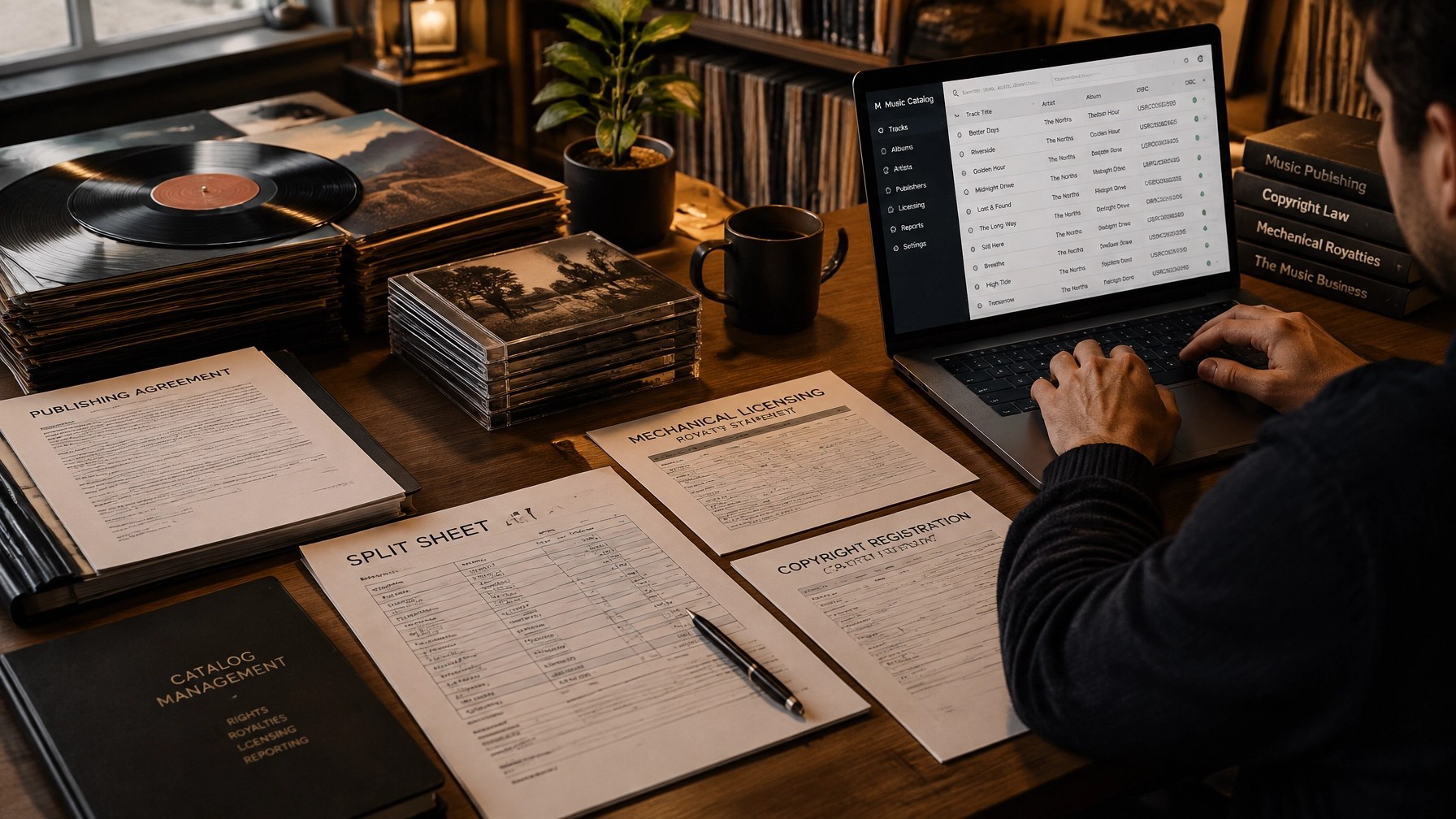
Catalog management brings those records together. It gives you one organized view of your songs, collaborators, identifiers, registrations, agreements, and ownership documents.
No organized record means no reliable way to check what is missing. Talent creates the opportunity. Infrastructure protects the value.
Five catalog checks The Mezzo Agency reviews before 2027
You don’t need to wait for a royalty statement to discover a problem. These are five catalog checks The Mezzo Agency reviews closely in a catalog, what we look for, and why it matters.
1. Whether every song can actually be found in The MLC Public Work Search
The first issue is visibility. The Mezzo Agency checks released and unreleased works where appropriate, along with alternate titles, spelling variations, and works registered by collaborators or publishers.
The question is not just whether a song exists somewhere in the system. The question is whether the record can be found clearly enough for the ownership trail to make sense.
The Mezzo Agency checks for:
- Whether the song is listed
- Whether the correct writers are attached
- Whether the ownership shares are complete
- Whether the publisher information is accurate
If those details are wrong or incomplete, royalties can stay unmatched or partially unclaimed.
2. Whether a missing member issue is blocking the money
The Mezzo Agency checks The MLC Missing Member Lookup for writer names, publisher names, legal names, professional names, company names, and prior publisher names.
This is one of the clearest ways to spot a structural issue: a work may be connected to royalties, but the right party may not have completed the membership or registration steps needed for payment.
That matters because royalties do not move simply because a song was used. They move when the ownership side of the record is connected to a registered, payable rightsholder.
3. Whether the ISWC and related metadata support a clean composition match
For each work, The Mezzo Agency checks the title, writers, publishers, ISWC, ownership shares, and whether sound recording identifiers, including ISRC information, align with the correct composition records.
This review is less about filling in fields and more about testing whether the composition data tells one consistent story across the catalog.
Metadata management is not busywork.
It is the information layer that helps royalties find the right destination.
4. Whether the splits tell the same story across organizations
The Mezzo Agency compares records across a PRO, The MLC, and any publisher or administrator.
This is not a simple PRO vs. The MLC vs. SoundExchange situation. These organizations handle different rights and royalty streams. Your records may legitimately look different in some areas.
But unexplained contradictions are a warning sign.
The Mezzo Agency checks:
- Writer shares
- Publisher shares
- Legal names and aliases
- Work titles
- Registration dates
- Ownership agreements
- Administrator information
When those records do not align, the problem is not just administrative. It can interrupt how money is matched, claimed, and paid.
5. Whether each song has one organized source record behind it
The Mezzo Agency checks whether each song’s record includes:
- Song title and alternate titles
- Writers and producer information
- Ownership splits
- Split sheets and agreements
- ISWC and ISRC information
- PRO registrations
- MLC registrations
- Copyright registration details
- Publisher or administrator information
- Release and usage history
- Notes about disputes or unresolved ownership
This is the foundation of a music catalog audit.
It is also the foundation of effective music rights management, music royalty collection, and long-term music catalog valuation.
When this record does not exist, even simple questions take too long to answer. When it does exist, catalog problems become diagnosable, fixable, and far less expensive over time.
The takeaway: organize before the 2027 distribution process begins
The upcoming MLC distribution process is important because it creates a defined timeline for money that has remained unmatched or unclaimed.
But the market-share process should not replace proper registration.
It should raise the urgency around what still has not been identified, claimed, or aligned.
Missing registrations, ownership conflicts, stale metadata, unclaimed shares, and scattered agreements all make it harder for royalties to reach the right owner over time.
The goal is not simply to receive a future payment. The goal is to know whether your catalog infrastructure is strong enough for your songwriter royalties, producer royalties, mechanical royalties, performance royalties, and music publishing royalties to be identified and collected over time.
That is the larger point behind this entire issue: talent creates the opportunity. Infrastructure protects the value.
Protect the work. Track the rights. Claim what you’re owed.
When did you last search your catalog using The MLC’s tools?
Source note
This article is based on information published by The MLC, including its Unclaimed Accrued Royalties dashboard:
For related context on catalog organization and administration, see The Mezzo Agency’s music administration services and catalog audit information.