The Physical Format Comeback Is a Royalty Event: CDs, Vinyl, and the Mechanical Money Most Streaming-Era Creators Never Set Up

Talent creates the opportunity. Infrastructure protects the value.
For years, many independent creators built their royalty expectations around streaming. You released music to digital platforms, watched the plays accumulate, and assumed the administrative side was covered.
But the market is changing again.
Physical music is not simply a nostalgia story. It is a growing revenue lane, and many streaming-era artists, songwriters, producers, and music entrepreneurs never set up the publishing infrastructure needed to collect every royalty connected to those sales.
That is the hard truth.
A physical sale can create money on the master side and the composition side. If your rights information is incomplete, your loss becomes someone else’s administrative gain.
Physical Music Is Growing Again
According to the RIAA’s 2026 Mid-Year Recorded Music Revenue Report, U.S. recorded music revenue reached approximately $6 billion during the first half of 2026.
Streaming still led the market. But physical formats showed the sharpest growth.
Here’s what the numbers show:
- Total physical revenue rose from $581.2 million to $731.5 million, an increase of 25.9%, or approximately 1.26 times the prior-year level.
- CD revenue rose from $107.9 million to $171.1 million, an increase of 58.6%, or approximately 1.59 times the prior-year level.
- Vinyl revenue rose from $461.9 million to $543.8 million, an increase of 17.7%, or approximately 1.18 times the prior-year level.
CDs generated the fastest growth. Vinyl remained the larger physical category by revenue.
This matters because every format creates a different administrative trail. Physical products involve manufacturing, distribution, sales reporting, licenses, ownership information, and composition rights. If those details do not connect correctly, the money may not reach the person who created the work.
Physical is back. Is your royalty infrastructure ready for it?

MLC & HFA Mechanical Royalties
This is where many creators need a clearer distinction.
A mechanical royalty is generated when a musical composition is reproduced. That can happen through a digital stream, a permanent download, a CD, a vinyl record, or another reproduction of the song.
But the collection lane depends on the format.
The MLC: Digital Mechanical Royalties
The Mechanical Licensing Collective administers U.S. digital audio mechanical royalties for eligible interactive streams and downloads.
The MLC collects usage data and royalties from digital service providers, matches reported uses to registered musical works, and distributes digital mechanical royalties to eligible members.
That means The MLC is connected to the composition, not the sound recording. It is not the same as your distributor, PRO, or SoundExchange.
The MLC does not replace:
- ASCAP or BMI royalties for public performance rights
- SoundExchange royalties for eligible digital performance of sound recordings
- Distributor income from the master recording
- Physical-format mechanical royalties
The MLC itself explains that creators affiliated with HFA still need to become MLC Members, or authorize a publisher, administrator, or collective management organization to collect on their behalf. One lane does not automatically cover the other.
HFA: Physical Mechanical Royalties
Harry Fox Agency handles licensing and royalty administration for many physical and other mechanical uses. For physical products such as CDs and vinyl, HFA pays mechanical royalties for compositions sold through applicable licensing arrangements.
That distinction is important.
The MLC pays digital mechanical royalties for compositions streamed on DSPs. HFA pays mechanical royalties for compositions sold in physical formats.
Creators can miss money in both lanes.
A songwriter may have a song streamed thousands of times but never properly registered with The MLC. A label or independent artist may sell CDs or vinyl but have incomplete composition ownership information, missing mechanical licensing records, or unclear publishing splits.
The result is the same: the music moves, but the money does not move correctly.
At The Mezzo Agency, we check both lanes as part of rights-focused catalog administration.
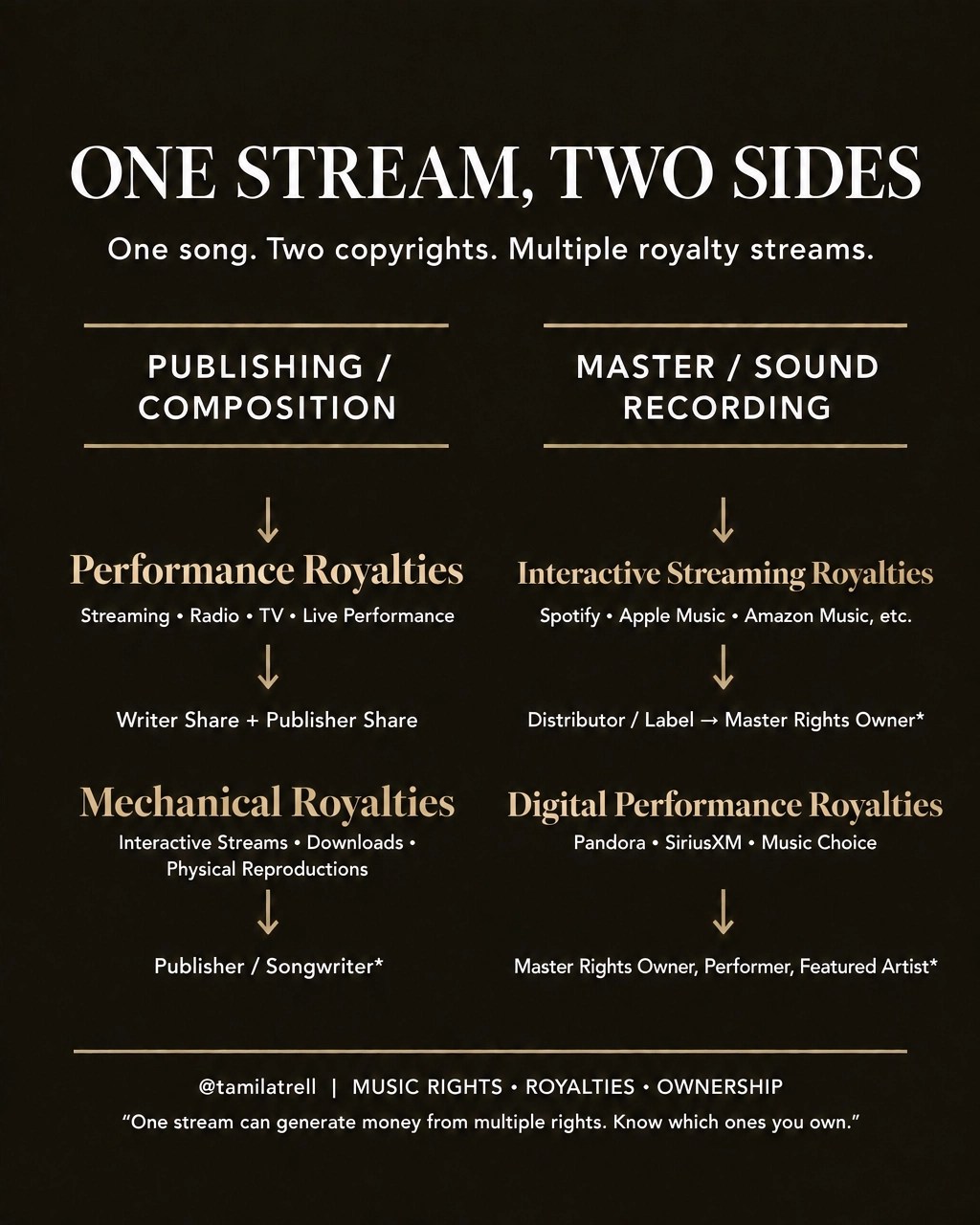
Your Physical Sales Are Not Only Master Revenue
A physical product usually involves at least two distinct rights:
- The master recording, the specific recorded performance
- The musical composition: the underlying song, lyrics, and music
If you are an independent artist who owns both sides, you may be entitled to revenue connected to both. If you are a songwriter, producer, or composer, your entitlement may depend on your ownership share and written agreements.
Do not assume that selling a record automatically settles every right.
A CD or vinyl release may involve:
- Mechanical royalties for the composition
- Revenue from the sale of the physical product
- Artist or label income connected to the master
- Producer compensation under a producer agreement
- Publishing income based on writer and publisher shares
- Licensing obligations for cover songs
- Accounting tied to manufacturing and distribution
Your distributor may report physical sales. Your label may account for physical revenue. A licensing agency may administer mechanical rights. A PRO may collect performance royalties from public uses.
Those are separate systems.
One sale can touch several rights owners and several payment channels.
Why Physical Releases Expose Weak Catalog Infrastructure
Physical releases require more than an audio file and cover art. They rely on accurate information at every stage.
That includes:
- Correct song titles
- Legal names and writer names
- Ownership shares
- Music royalty splits
- Publisher information
- PRO affiliations
- ISRC and UPC information
- Release and manufacturing details
- Cover-song licensing information
- Agreements between artists, songwriters, producers, and labels
If your catalog contains inconsistent titles, missing collaborators, incorrect ownership shares, or incomplete publishing information, those errors can follow the release into every royalty system connected to it.
Watch out for these common assumptions:
“My distributor handles all of my royalties.”
A distributor may handle certain master-recording income and may offer additional services. That does not mean every composition royalty has been registered, matched, or collected.
“I joined a PRO, so I’m covered.”
A PRO generally handles public performance royalties. It does not replace The MLC for U.S. digital mechanical royalties, HFA for applicable physical mechanical licensing, or SoundExchange for eligible digital performance royalties.
“The label pressed the records, so the paperwork is complete.”
Manufacturing a product does not guarantee that every songwriter, publisher, producer, or rights owner is correctly identified.
“I only sold a small run.”
Small sales still create rights obligations. Small money can also become meaningful money when a catalog grows across multiple releases, territories, and years.
No registration, no reliable match. No reliable match, no dependable payout.
What The Mezzo Agency Checks
The Mezzo Agency provides music administration support for independent artists, songwriters, composers, producers, and music entrepreneurs whose catalogs need stronger organization and rights visibility.
For physical-format royalty questions, our work is centered on the health of the catalog, not on treating one sale as an isolated event.
Through Catalog Management, The Mezzo Agency helps document and organize information such as:
- Song and release titles
- Writers and collaborators
- Ownership shares
- Publishing information
- ISRC and UPC details
- Registration records
- Rights relationships
- Release and catalog history
Through royalty-focused services, we examine whether your music is positioned across the relevant collection channels, including digital mechanical royalties, physical mechanical royalties, performance royalties, and other rights connected to your work.
We also provide Catalog Audit support for creators who need a closer review of missing or inaccurate information across their catalog.
The goal is not to take ownership away from you.
You retain 100% ownership of your copyrights. We help bring the administrative picture into focus so your rights can be documented, protected, and connected to the money your music generates.
Physical Music Is a Business Opportunity
The renewed interest in CDs and vinyl gives independent creators another way to build deeper relationships with listeners. A physical release can create a collectible product, strengthen fan connection, and extend the life of a project.
But opportunity without administration creates exposure.
Before you press another run, revisit your catalog records. Before you accept a royalty statement, understand which rights it covers. Before you assume a platform, distributor, label, PRO, or licensing agency has handled everything, identify what that relationship actually includes.
Ask yourself:
- Are all writers and producers correctly documented?
- Are the composition and master rights clearly separated?
- Are your songs registered in the relevant systems?
- Do your physical releases have complete licensing and ownership information?
- Can you trace a sale back to the correct work and rights holder?
- Do your catalog records support future royalty collection and valuation?
If you cannot answer confidently, do not ignore the gap.
The physical-format comeback is not just a cultural moment. It is a reminder that every format needs rights infrastructure.
Talent creates the opportunity. Infrastructure protects the value.
Save this article for your next release review, share it with a songwriter or producer in your circle, and continue reading educational coverage on The Mezzo Agency blog.
#MusicPublishing



