DistroKid Is Now Selling Publishing Administration: What to Verify Before You Pay the $75

By Tami LaTrell, music publishing executive and rights strategist
DistroKid launched DistroKid Publishing on November 11, 2026, powered by Kobalt. The service was first unveiled in a DistroKid blog post on October 5, with eligibility rolling out gradually. For eligible songwriters, the offer is a one-time $75 setup fee in exchange for 80% of publishing royalties collected on their behalf. Music Business Worldwide covered the launch.
The launch makes a publishing decision available inside a distributor’s dashboard. That convenience may be appealing, but it does not make distribution and publishing administration the same job. Before paying, understand what each service handles, which royalties are included, and how it fits with your existing registrations.
Distribution versus publishing administration
A distributor delivers recordings to streaming services and other platforms, then collects and pays out master recording royalties according to its agreement with the artist or rights holder. Those royalties relate to the sound recording.
Music publishing administration deals with the underlying composition: the song’s music and lyrics. An administrator documents and registers compositions, tracks their uses, works with performing rights organizations (PROs), The MLC and counterpart societies abroad, and collects and reconciles publishing royalties. Mechanical royalties and performance royalties are two important categories on this side of a song’s rights.
Delivering audio is not registering a composition. A recording can be available on streaming platforms while the songwriters’ composition information is missing, incomplete or mismatched in the systems that help identify and pay the writers.
DistroKid says its new service collects mechanical and public performance royalties, with payouts sent to the writer’s DistroKid Bank account. According to the company, a first payment typically arrives six to nine months after publishing earnings exceed $10, with quarterly payments after that. That timing is worth factoring into your decision: signing up does not mean a quick or immediate payout.
What the 20% commission actually buys
The offer is an 80/20 split: the songwriter receives 80% of publishing royalties collected on their behalf, and the service retains 20%. The $75 is a one-time setup fee, not the only cost to consider. The continuing commission applies to royalties collected under the agreement, so read the contract to understand what income it covers.
That 20% should be assessed against the work performed. Publishing administration may involve researching and registering works, maintaining accurate writer and ownership information, matching usage to songs, resolving conflicting data, following up on royalties and reconciling payments across territories. The details matter. A commission percentage on its own does not tell you how complete the service is, how clearly it reports activity or how it handles problems.
Under a publishing administration arrangement, the writer retains copyright ownership. Administration authority is not the same thing as a copyright transfer. Still, check the agreement itself: confirm what rights the administrator is authorized to administer, for which works and territories, and what happens when you leave.
Kobalt estimated in February 2025 that more than $1 billion in publishing royalties go uncollected each year. That figure is a reminder that identification and registration matter, not a guarantee that any service will find or collect a particular writer’s unclaimed music royalties.
The writer’s share and the publisher’s share, through a PRO
In the United States, PROs such as ASCAP, BMI, SESAC and GMR license public performances of compositions and distribute performance royalties. A song’s performance income can include a writer’s share and a publisher’s share. Those are distinct royalty shares, so ask how your agreement and existing registrations affect each one.
DistroKid says a PRO is not required to sign up, but that PRO affiliation can unlock more royalties. The practical question is which share can be collected and paid when you are not affiliated with a PRO, and what you may need to do to receive the writer’s share. Ask for a clear explanation of how the service coordinates with your PRO rather than assuming “publishing royalties” means every share is covered in the same way.
It also helps to keep the systems straight when thinking about PRO vs The MLC vs SoundExchange. PROs handle public performance royalties for compositions. The MLC handles U.S. digital audio mechanical royalties. SoundExchange is associated with certain digital performance royalties for sound recordings, not the composition’s publishing royalties. These systems address different rights and uses; registering with one does not automatically take care of all the others.
MLC & HFA Mechanical Royalties
The MLC pays digital mechanical royalties for eligible streaming uses on digital service providers (DSPs). HFA handles mechanical royalties for physical copies. Those are separate lanes to review when you are checking whether your catalog is registered and accounted for.
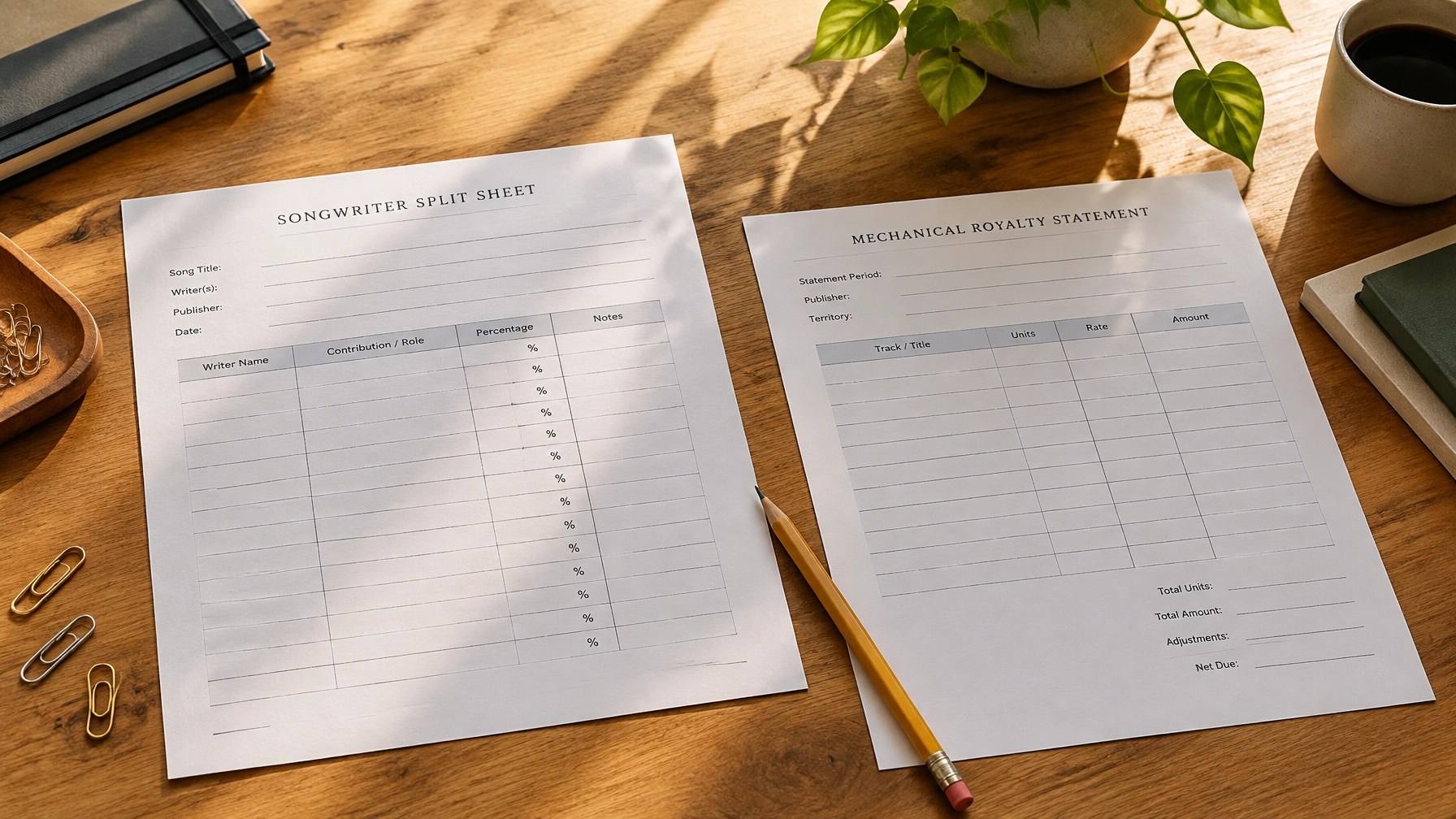
The Mezzo Agency checks both lanes. For a new administrator, ask whether each work has been registered correctly with The MLC, whether mechanical royalties from physical products are being handled, and whether the writer and publisher shares are recorded accurately in each system. If your name, song title or split differs between records, payments may not match cleanly to your work.
Questions to ask before the $75 is charged
- Who owns the copyright after signing?
- Is the publisher share retained by the writer or taken by the administrator?
- What happens to existing PRO and MLC registrations?
- What are the exit terms, and how long does the administrator keep collecting after a writer leaves?
- What data does the writer get back when they leave?
- Who fixes bad metadata and name mismatches?
- How detailed is the royalty reporting?
- Are international collection and sub-publishing included?
- Can the same catalog be administered by a specialist at the same time?
DistroKid says there is no long-term commitment and members can leave at any time. Treat that as a starting point, not the whole answer. Read the agreement for the process of ending administration, handling existing registrations and collecting royalties that relate to the period you were enrolled.
What The Mezzo Agency Checks
When reviewing a creator’s catalog, The Mezzo Agency looks at the records and administration that support accurate rights tracking and royalty collection.
That review can include catalog documentation: organizing song titles, contributor names, ownership shares and other key information so works can be identified consistently. It can include copyright registration, as well as checking PRO and MLC registration details and whether information is aligned across systems.
The review may also consider royalty collection and research into unclaimed royalties, along with music publishing administration needs. The goal is to understand what is already in place, identify gaps that need attention and help the creator determine which administrative steps fit their catalog.
The Mezzo Agency’s services page outlines its administrative support, including catalog management, registrations and royalty collection. The right review depends on the creator’s works, agreements and current registrations.
Who this is a fit for, stated honestly
A distributor’s publishing administration option can be reasonable for a writer with a small, simple, single-territory catalog and one release, especially if the writer meets the eligibility requirements and understands the agreement. DistroKid says a songwriter needs at least one release on DistroKid and more than $50 in streaming revenue over the past 12 months. Only original songs, including co-writes, qualify, even if the writer owns only a share. Covers, remixes, mash-ups and fully AI-generated tracks are excluded.
A specialist administrator may make more sense when a catalog includes co-writes and splits that need reconciling, a back catalog with missing or inconsistent registrations, physical product, international income, licensing activity or potential unclaimed royalties to research. Those situations can call for more hands-on catalog review and follow-through than a quick enrollment decision alone.
Neither the setup fee nor the commission percentage can tell you whether a service is right for your songs. Start with your rights, registrations, royalty sources and the terms of any existing agreements.
Take these steps before you decide
- List your songs, co-writers, ownership shares and current administrators.
- Check which works already have PRO, MLC or other publishing registrations.
- Read the agreement closely, especially the commission, royalty coverage and exit terms.
- Confirm which shares and royalty types the service will collect for your situation.
- Compare the work your catalog needs with the service’s reporting and administration scope.
If you would like help reviewing your catalog and deciding which administrative steps may fit, book a free call or request a catalog review with The Mezzo Agency.
Talent creates the opportunity. Infrastructure protects the value.
#MusicPublishing