The Coffee Shop Is the New Radio: Where Songwriter Royalties Are Really Coming From in 2026

By Tami LaTrell, music publishing executive and rights strategist
Global creator royalties reached a record $15.9 billion in 2025 (CISAC Global Collections Report, out November 4). The important detail is what that number represents: CISAC’s reported total was €15.5 billion across five creative repertoires, while $15.9 billion is the U.S. dollar conversion of the music-specific total, €14.06 billion.
The report also points to a shift worth understanding. Music royalties from Live & Background uses (including concerts and music played in shops, restaurants, hotels, and gyms) reached €3.62 billion, overtaking TV and radio at €3.32 billion as songwriters’ second-largest music income source. Digital grew 27.9% to €6.41 billion, or 45.6% of music collections.
That is why I say the coffee shop is the new radio. Not because a coffee shop has replaced radio, or because CISAC reports a separate “coffee shop” royalty category. The point is that everyday public spaces are part of a growing performance-royalty landscape, and your songs need to be registered and identifiable if you expect your share to find its way to you.
What “background use” means
Background use is music played in a public or commercial setting as part of the atmosphere, rather than as the main event. Think of a playlist in a coffee shop, music in a hotel lobby, or songs playing across a retail store or fitness studio.
When a song is played in public, the composition, the underlying music and lyrics, may be subject to a public-performance license. In the United States, performing rights organizations (PROs) such as ASCAP, BMI, SESAC, and GMR license performance rights in the compositions they represent. Rules and organizations vary by country, but the general principle is that public uses can generate performance royalties for songwriters and publishers.
A café or store may get permission through a blanket license. In plain English, that license lets the venue publicly perform works in a PRO’s represented catalog, subject to the license’s terms. It means the business doesn’t have to negotiate permission with every songwriter each time it plays a song. The venue pays the licensing organization; the PRO then distributes royalties to eligible writers and publishers.
A blanket license is not an individual payment to every songwriter whose song might have played that day. The PRO has to connect collected money with reported or otherwise documented use. Depending on the organization and territory, it may use venue reporting, playlists, surveys, sampling, live performance submissions, or other data. The specific method matters, and not every public play is necessarily tracked individually.

Hotel lobbies, like shops and restaurants, are among the public spaces included in CISAC’s Live & Background category.
The money can be collected and still miss you
A songwriter’s work can be played in a licensed venue, and a PRO can collect money associated with public performances, without that money automatically reaching the right creator. The work needs to be registered in the relevant system, with accurate information connecting it to the correct writers and publishers.
That means a song title alone is not enough. The record may need to identify each songwriter, their share, any publisher or administrator, and the identifiers used by the relevant organizations. Names should be consistent, and ownership shares should match the agreed split. If registration details conflict, or a work is missing from a PRO’s database, the organization may have difficulty matching usage to the people entitled to payment.
This is why PRO registration and clean music metadata management are not housekeeping tasks to leave for later. They are part of the infrastructure that makes royalty matching possible. A public performance can create an opportunity for income, but incomplete or inconsistent records can interrupt the path from use to payment.
As a practical matter, registering a song with a PRO does not guarantee that every café play will produce a line item on your statement. Distribution depends on the PRO’s data and rules, reporting practices, your eligibility, and the registration itself. But without correct registration, you make it harder for the system to identify your share at all.
Also keep the rights clear. A PRO generally handles performance royalties for the composition, not every right connected to a recording. In the U.S., the sound recording and the composition are different copyrights, and use of a recording may involve separate licensing or collection arrangements. Registering your composition with a PRO does not, by itself, register all rights in a master recording.
What a songwriter should check now
Start with the records you control. For every released work, confirm that its title, songwriter names, ownership splits, publisher information, and relevant identifiers agree across your split sheet, PRO account, and catalog records. If you use alternate names, check that those are handled correctly in the applicable registration systems.
Then confirm that the work is registered with the PRO or society responsible for your performance royalties. If you have a publisher or administrator, clarify who is responsible for registration and what has actually been submitted. Do not assume a distributor’s delivery of a release to streaming services has completed your composition registration.
If you perform your songs live, look up your PRO’s process for reporting eligible performances. A venue’s blanket license and a set-list reporting program are not the same thing; submitting eligible performance information may be a separate step. Check your organization’s current rules rather than assuming a performance will be captured automatically.
Finally, review your statements and investigate gaps. Compare registered works to your release and writing history. Look for missing titles, duplicate entries, incorrect writer names, mismatched shares, or works attributed to the wrong publisher. A statement that does not show a particular use is a reason to examine the data and reporting path, not proof on its own that royalties are owed or missing.
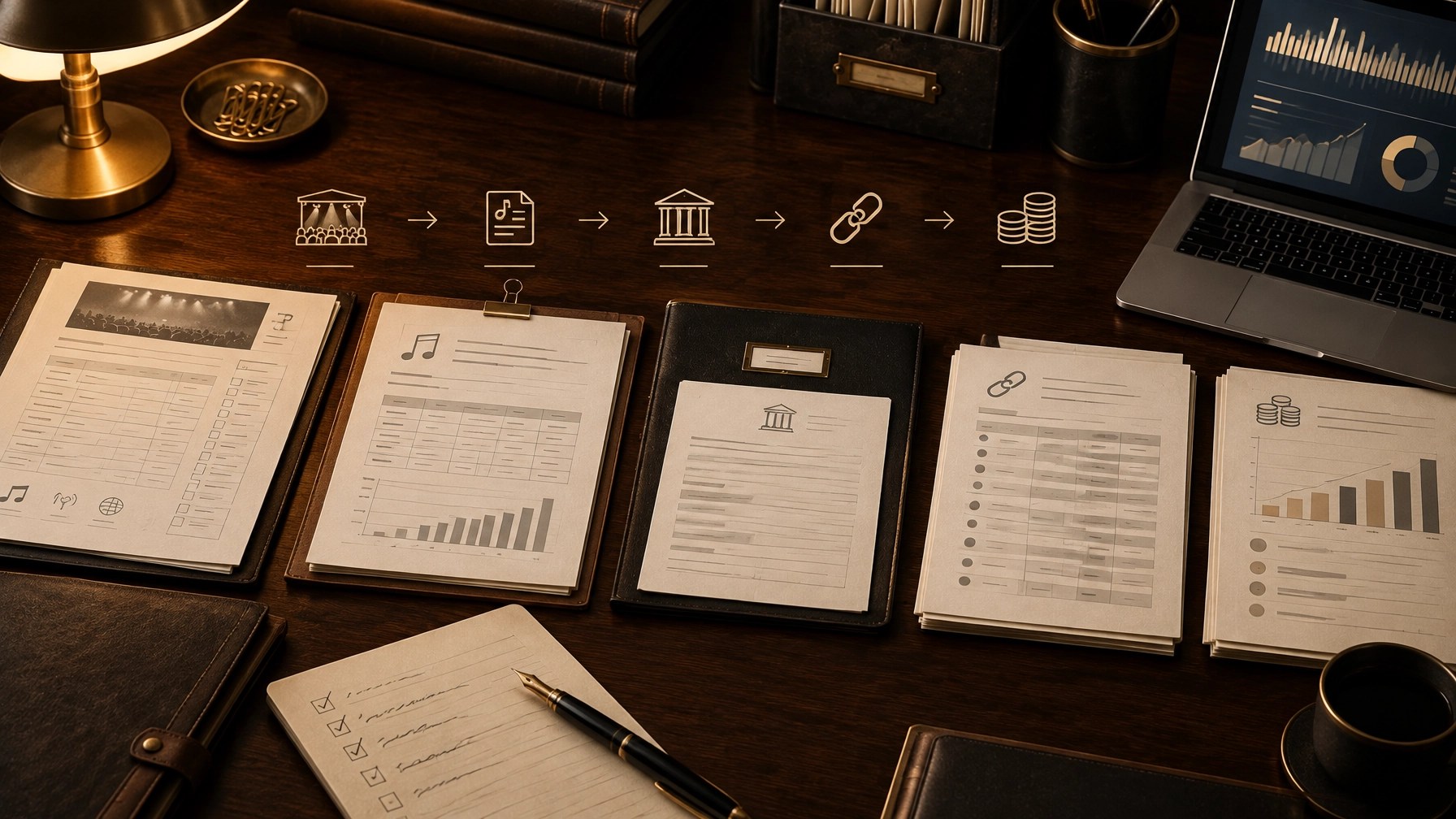
PRO registration paperwork and royalty records help creators check whether their works can be accurately identified and matched.
What The Mezzo Agency Checks
When reviewing a catalog’s performance-royalty readiness, The Mezzo Agency checks whether the underlying records make each work identifiable and administrable. That includes comparing song titles and writer names, reviewing splits and publisher details, and looking for missing, conflicting, or duplicate work registrations.
We also look at whether PRO affiliation and work registration details are clear, whether relevant identifiers and alternate names are consistent, and whether the creator has a process for reporting eligible live performances. Where appropriate, we can review royalty information and identify questions that may need follow-up with a PRO or other administrator.
The goal is not to promise a payment from every public play. It is to strengthen the records and registration process so your catalog is better positioned to be matched, monitored, and administered across relevant royalty channels.
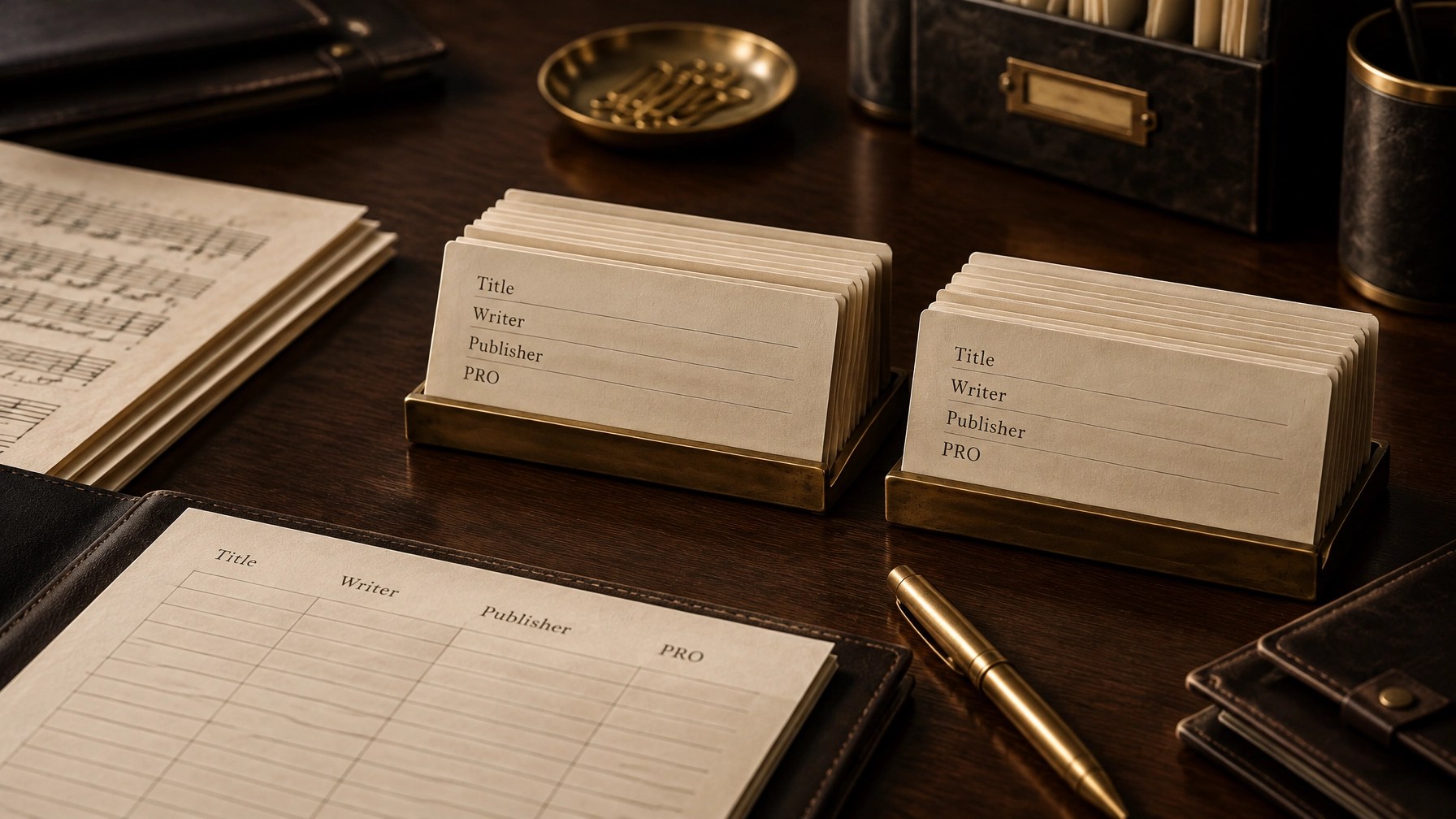
Clear title, writer, publisher, and PRO fields make a catalog easier to check and administer.
The takeaway: register for where the money is
CISAC’s 2026 report is a reminder that songwriter income comes from more than the channels creators tend to watch most closely. Its music-specific Live & Background category, including concerts and background music in public venues, has overtaken TV and radio in collections. The category is broad, and it does not tell us what any one coffee shop paid or which songs played there. But it does show why performance royalties deserve a place in a creator’s registration plan.
Don’t register for where you think the money is. Register everywhere the money now is.
Take these steps:
- List every composition you own or co-wrote and confirm its writers, splits, publisher details, and identifiers.
- Check that each work is registered with the relevant PRO or collecting society and that the details match your records.
- Ask your PRO how it handles venue uses and eligible live-performance reporting in the territories where your music is used.
- Review statements and investigate catalog gaps instead of assuming that registration or a public play guarantees payment.
Talent creates the opportunity. Infrastructure protects the value.
For the report’s full context, read the CISAC Global Collections Report 2026, its November 4 news release, and Music Business Worldwide’s report breakdown. For practical next steps, explore the Mezzo Agency blog library or request a catalog review or free call.
#MusicPublishing

You Might Also Like


